Research
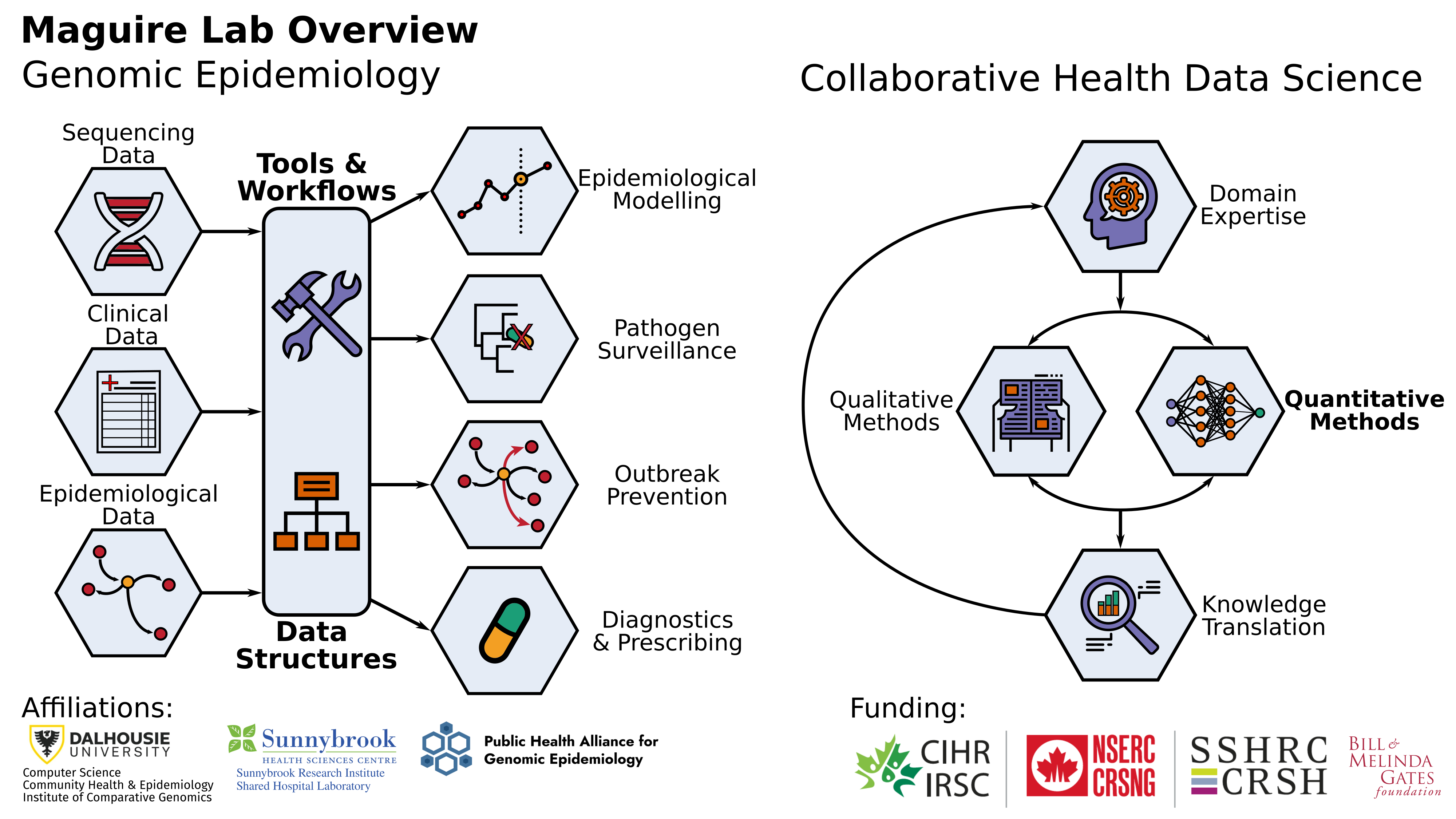
Our work develops new ways to apply data to health and social crises, in collaboration with the people closest to them. This primarily involves the genomic epidemiology of infectious diseases (including microbial bioinformatics more widely) as well as a subset of health data science related projects.
Antimicrobial Resistance
The evolution and spread of antimicrobial resistance (AMR) is our longest-running focus. We develop bioinformatic and machine learning methods that use genomic and metagenomic data to mitigate AMR more effectively in clinical and public health contexts. This includes machine learning models for predicting resistance phenotype from genotype, novel algorithms for finding AMR genes and understanding their evolutionary and genomic context, tools to automate the interpretation and contextualisation of clinical AMR genomic data, and methods for tracking mobile AMR genes across environments.
This work is carried out in collaboration with the Comprehensive Antibiotic Resistance Database (CARD), the Public Health Agency of Canada’s National Microbiology Lab, Agriculture and Agri-Food Canada, and the Canadian Food Inspection Agency.
We are also developing international evidence-based rules for interpreting resistance genotypes in clinical practice through AMRrules, a project of the European Society of Clinical Microbiology and Infectious Diseases (ESCMID), and sit on Nova Scotia’s AMR Research Pillar Working Group.
Emerging and Zoonotic Viruses
We sequence and analyse viruses of zoonotic potential from both the clinic and Canadian wildlife, including SARS-CoV-2 and other alpha- and betacoronaviruses, paramyxoviruses, and avian influenza. For example, we previously characterised the spillover of SARS-CoV-2 variants of concern into white-tailed deer, and identified a highly divergent deer-derived lineage together with a probable deer-to-human spillback — the first documented case of the virus establishing in a wildlife reservoir, evolving there, and re-infecting a person.
Current work extends this to highly pathogenic avian influenza — predictive modelling of H5Nx host and antigenic transitions, and machine learning to assess the risk new variants pose to animal, ecosystem, and public health with the National Centre for Foreign Animal Disease — and to the ecology and evolution of coronaviruses circulating in Canadian wildlife.
This research largely takes place as part of a multidisciplinary national consortium of bench, field, and computational groups: the Wildlife Emerging Pathogens Initiative (Wild-EPI).
Clinical and Public Health Genomics
We are heavily involved in translating our research work directly into clinical and public health decision-making. We lead pathogen genomics for Toronto’s Shared Hospital Laboratory (located at Sunnybrook), an accredited service covering more than twelve hospitals, where sequencing informs diagnosis, treatment guidance, and infection prevention and control.
During the COVID-19 pandemic we co-developed the SIGNAL viral genome analysis workflow and its quality control tooling, used by the Public Health Agency of Canada and others to generate over a million SARS-CoV-2 genomes, and contributed functionality to the internationally adopted pangolin lineage assignment tool. We continue to contribute to national and provincial surveillance networks, including the Canadian COVID Genomics Network (CanCOGeN) and the Ontario COVID Genomics Network.
Open Standards and Equitable Data Sharing
Genomic data only helps public health if it can be shared, compared, and interpreted consistently. Through the Public Health Alliance for Genomic Epidemiology (PHA4GE), where we sit on the steering committee and co-chair the Data Structures working group, we develop open data models, contextual metadata specifications, and quality control standards for pathogen sequencing. These specifications have been adopted by more than 35 national public health institutes, and the work feeds into WHO initiatives including the International Pathogen Surveillance Network and the global genomic surveillance strategy for pathogens with pandemic and epidemic potential.
We are also a founding member of Pathoplexus, an open pathogen genome database built to support rapid data sharing during health emergencies while protecting the rights of the groups that generate the data, particularly in low- and middle-income countries.
Collaborative Data Science
This work involves finding collaborators with expertise in a given applied domain such as Tamara Sorenson-Duncan in language acquisition, Michael Halpin in sociology, and Jocelyn Stairs in refugee women’s health. These experts have data-related problems ranging from a simple need for visualisation/exploratory data analysis to more complex questions requiring careful application of ecological statistics and machine learning methods. Through these collaborations we’ve been involved in identifying and lobbying for improved health provision for refugee women, identifying signatures of online radicalisation, and developing improved understanding of the role of social media in language development.
Ongoing work in this area combines natural language processing with qualitative sociological methods to characterise misogyny and radicalisation in male-oriented online communities, and has produced the concept of “stochastic gender-based violence”, now used to describe how online misogyny translates into offline harm.
Training and Research Capacity
Finally, we co-lead several national graduate and postdoctoral training platforms, including the Canadian One Health Training Platform on Emerging Zoonoses, the Canadian One Health Antimicrobial Resistance Training Platform (CAN-AMR-Net), and the Canadian Computational Biology, Bioinformatics and Data Science platform (CCBB).
This also extends to work developing research capacity to empower individuals to ask and answer their own research questions. MicroResearch and the Halifax Community Learning Network are great initiatives that we actively support and contribute towards; MicroResearch workshops have been run with community teams in Nova Scotia, Uganda, Kenya, and Ghana.